Cards in a Cardboard Box: A 30-Second Toddler Fine Motor Activity (Ages 2-4)

By Katie · Mom of 2 under 3. Founder, Screen Free Toddlers.
· 7 min read · @screenfree_toddlers
Slip cards through a slit in a cardboard box. 30-second setup, focused fine motor practice for toddlers ages 2-4. Step-by-step guide tested at home.
Time: 1.5 minutes | Age: 2-4 years | Setup: 30 seconds | Mess Level: Low
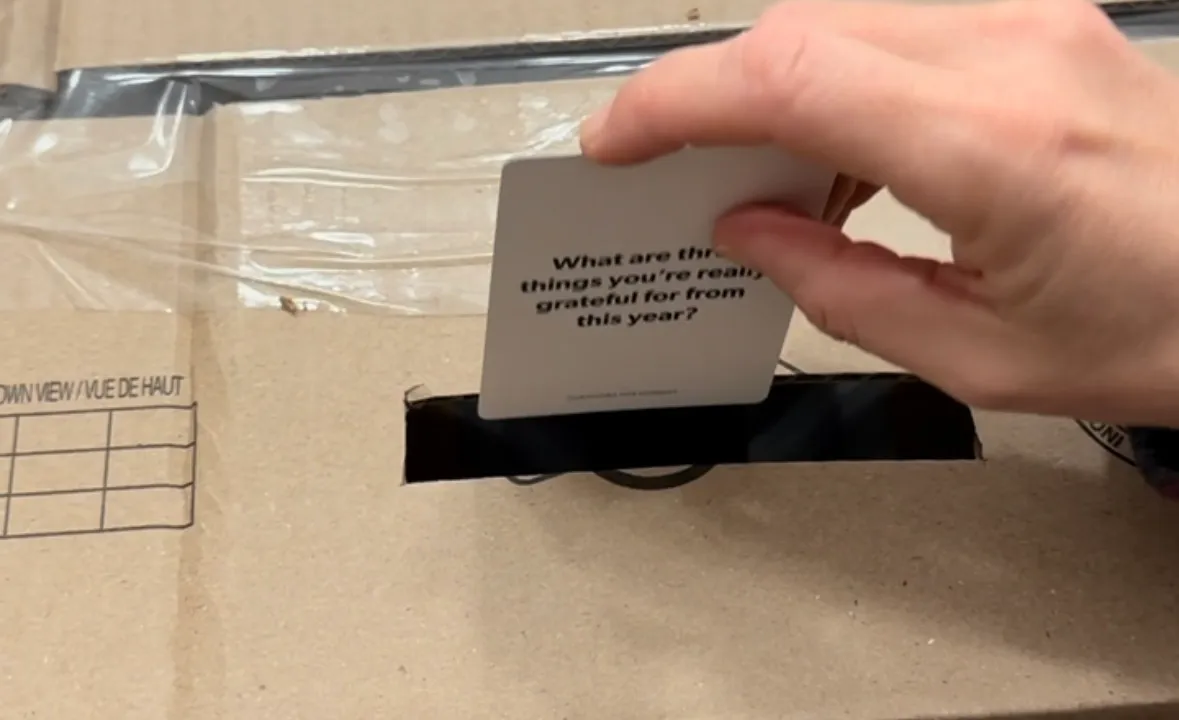
Cards in a cardboard box. That is the whole activity. Cut a slit in any old shipping box, hand your toddler a stack of playing cards, and watch her post the cards through the slit one at a time. Setup took me 30 seconds. The first round of focused play lasted about a minute and a half. And honestly, that minute and a half was everything.
If your toddler is in the put-stuff-in-stuff phase, the cards in a cardboard box activity is the lowest-effort, highest-payoff thing in the entire screen-free playbook. It hits a really specific developmental sweet spot. Pinch the card. Line up the slit. Push it through. Repeat. Each rep is a tiny piece of fine motor practice, the same hand muscles she will need for buttons, zippers, and eventually a pencil.
Below is the exact setup, what happened when I tried it with my toddler, age tweaks for 2, 3, and 4-year-olds, and the questions parents ask most often before trying this one.
Why Cards in a Cardboard Box Works for Toddlers
Toddlers between 18 months and 3 years are wired for what occupational therapists call posting play. They want to take an object from one place and put it into another, and they want to do this hundreds of times. The cards in a cardboard box activity gives that drive a productive outlet.
Pinching a flat playing card and lining it up with a narrow slit builds the pincer grasp, the same fine motor pattern toddlers use for picking up Cheerios, then crayons, then a pencil. The narrow slit forces the wrist to rotate to find the right angle, which builds wrist mobility. Each successful post gives a small dopamine hit of cause and effect. The card disappears. The card stays in the box. She did that.
It is also one of the cleanest ways to satisfy the put-stuff-in-stuff phase without a single piece of plastic.
What You Need
- 1 cardboard box (any size, an old shipping box, shoebox, or even a cereal box works)
- 1 deck of playing cards (a standard deck or any kid-friendly set)
- A box cutter or sharp scissors for the adult to cut the slit
How to Set Up Cards in a Cardboard Box
- Choose a cardboard box sturdy enough to sit upright on the floor or a low table.
- Use a box cutter or sharp scissors to cut a horizontal slit in the top, about 4 inches wide and just slightly wider than a playing card.
- Run your finger around the slit to smooth any rough edges so it does not scrape little hands.
- Tape the box flaps shut underneath so the box behaves like a closed container and does not collapse.
- Place the box on a low table or directly on the floor so your toddler can stand or sit comfortably next to it.
- Hand her the stack of cards, demonstrate posting one through the slit, then step back and let her take over.
Love this one? There are 75 more.
The 75 Toddler Activities Guide is a flip-through bank of screen-free activities, all using things you already have at home. Pick one, set it up, buy yourself 15–20 minutes.
See the 75 Activities Guide →Age Tweaks
Age 2: At 2, the slit alignment is the whole challenge. Make the slit a touch wider than a card so success comes fast, because frustration shuts a 2-year-old down. Sit next to her and demonstrate two or three times before handing the cards over. If she gets stuck, offer one card at a time instead of the whole stack.
Age 3: At 3, narrow the slit so alignment is harder, and add a layer on top. Count each card out loud as she posts it, or ask her to put in only the red cards or only the cards with numbers. That adds visual sorting on top of the fine motor work without changing the setup.
Age 4: By 4, plain card-posting is too easy. Cut multiple slits on different sides of the box and label each one (numbers, letters, colors). She has to match each card to the correct slit before posting. You can also hide a small toy inside and have her unload all the cards at the end to rescue it.
What Happened When We Did It
She stayed with this for about a minute and a half. That is it. But here is why I am calling it a win anyway. That 90 seconds was completely focused play. She was not asking me for anything. She was not dumping the cards out and walking away. She was concentrating, posting card after card, looking up at me to confirm I was watching, then back to the box.
That minute 28 seconds was everything. With a toddler, the threshold for a good activity is not half an hour of independent play. It is any window of focus that lets you get something done or just sit down for a second.
Setup time was around 30 seconds. So even if she only plays for 90 seconds, the ratio is favorable. Not every activity needs to last 20 minutes to be worth it.
No energy to plan tomorrow's activity?
The 75 Toddler Activities Guide does the thinking for you. 75 ideas sorted by setup time and materials. Less mental load for you, a happy and engaged toddler for them.
Get the 75 Activities Guide →Common Issues and Troubleshooting
My toddler is not interested. Try a different object instead of cards. Some toddlers find playing cards too thin to grip. Coasters, popsicle sticks, or small wooden blocks (cut a wider slot) all work for the same posting motion. The goal is the action of putting one thing into another, not the cards themselves.
She is pulling the box apart instead of using the slit. This usually means the slit is too narrow or the box flaps are loose. Tape the bottom flaps shut so the box is rigid, then widen the slit by half an inch. If she still pries at the seams, switch to a smaller, sturdier box like a cereal box.
She finished in 30 seconds. She probably only had 5 or 10 cards in her hand. Hand her the whole deck at once, or stack the cards in a separate bowl across the room so she has to grab one, walk to the box, post it, and walk back. The trip back and forth doubles the play time without changing the activity.
Frequently Asked Questions
What age is the cards in a cardboard box activity good for? This activity works best for toddlers between 18 months and 3 years, when the put-stuff-in-stuff phase is at its peak. Older 3- and 4-year-olds can still enjoy it with the harder variations (sorting by color, multiple slits, counting cards) listed in the age tweaks above.
Is this safe for toddlers who still mouth things? Yes, with two adjustments. Use thicker cards (kid playing cards or even cardboard squares cut from another box) so they will not be chewed and softened. Supervise the first few minutes to make sure she is posting and not eating.
How do I clean up after this activity? Cleanup takes 30 seconds. Open the box, dump the cards back into the deck, set the box aside for next time. I save the prepped box for a few days because the slit is the only setup work and reusing it costs nothing.
Can I prep this activity ahead of time? Yes. Cut the slit, tape the flaps, and stash the box in a closet. Pull it out during the witching hour when you need 90 seconds of focus to start dinner.
What if I do not have playing cards? Use index cards, postcards, business cards, or the loyalty cards in your wallet you have been meaning to throw out. Anything thin and rectangular that is roughly the same size will work.
Mom to Mom
This is one of the activities I reach for when I have zero energy and just need to give my toddler something to do for two minutes while I refill my coffee. Setup is so fast that even a short play window justifies it. If yours does not engage right away, leave the box out and try again the next day. Sometimes they need to see something sitting on the counter for a while before they decide it is interesting.
Cards in a cardboard box is great when you have 30 seconds and a recycling bin nearby. When you do not, the 75 Toddler Activities Guide does the thinking for you. 75 screen-free activities you can flip through in seconds, all using stuff already in your house. Pick one, set it up, and buy yourself 15-20 minutes. No prep spirals, no Pinterest searching, no guilt.
Want tonight's dinner hour back?
Drop your email. I'll send you TONIGHT, a 3-step reset plan plus 4 setup-free activities for the meltdown hour.
By signing up, you agree to receive the guide and emails from Katie. Unsubscribe anytime.